
AI firewall
HEIMDALL Use cloud AI. Keep your secrets.
Checks every request before it leaves your house.
LOKI runs in your house. Without the cloud. Some tasks run better on a large cloud model. Then HEIMDALL checks every request before it leaves your house.
How HEIMDALL works
Names stay in house.
You write your request the way you always do.
In the gate, names become placeholders. Only then does the request go to the cloud AI.
The answer comes back. HEIMDALL puts the names back in.
The cloud AI helped. It never saw your names.
How it works
Real names inside. Only placeholders outside.
You write real names and real figures. HEIMDALL replaces sensitive details with placeholders before the request leaves your house.
Scene: A request names a person, a customer number and an IBAN. HEIMDALL detects the three details and replaces them with placeholders before the request goes to a cloud model.
Your request. Just as you write it.
HEIMDALL detects what must not leave the building.
And replaces it with placeholders. Only this goes to the cloud.
The cloud never saw Karin Wolters.
Example. Name, customer number and account number are invented.
Hard rules for the known.
IBANs, credit cards, tax IDs, API keys and passwords: built in, and no AI can overrule them.
AI for the unexpected.
A local model catches what no list contains: the project name, the internal shorthand, the delicate connection.
Reads what you send along, too.
HEIMDALL also checks document passages sent along, text from attachments and mail content from Outlook.1
¹ With Microsoft 365.
Day to day
Unobtrusive. But visible.
We refuse to run a covert filter: because of co-determination, because of transparency obligations, and because every employee should see daily that the company protects its data.
Cloud model active. Your messages are sent to an external provider.HEIMDALL is active and checks all outgoing data against your company policies.
Write Karin Wolters a reply to her complaint about the press in Hall 2. Customer number K-20388. The credit goes to DE89 3704 0044 0532 0130 00.
Compliance check
- Person
- “Karin Wolters”→
⟨PERSON_A⟩ - Customer number
- “K-20388”→
⟨CUSTOMER_A⟩ - IBAN
- “DE89 3704 0044 0532 0130 00”→
⟨IBAN_A⟩
Policy “IT Policy §4.2: Cloud AI Use”
How would you like to proceed?
Your decision is recorded in the compliance audit log.
Nothing goes out.
Call cancelled
The request contains details your policy protects: person, customer number, IBAN.
The call ends here. The chat says why. And the audit log records your decision.
Stays in house.
A local model answers
Hello Karin Wolters, we have reviewed your complaint about the press in Hall 2. The credit for customer number K-20388 goes to account DE89 3704 0044 0532 0130 00.
Local models never pass through HEIMDALL, because everything stays in the house. From then on, the chat stays local.
Goes out protected.
What your request looked like to the cloud
Write ⟨PERSON_A⟩ a reply to her complaint about the press in Hall 2. Customer number ⟨CUSTOMER_A⟩. The credit goes to ⟨IBAN_A⟩.
3 details protected. That is all the provider sees.
In regular operation “send protected” is the default: one discreet note per intervention, not one click more than necessary.
Example, re-created from the LOKI interface. Names and figures are invented.
The notice in the tool.
When a cloud model is active, LOKI says so openly. And it says that HEIMDALL checks every outgoing request against company policy.
The compliance dialog.
In warning mode HEIMDALL asks whenever content is flagged, naming the policy that applies. So you always know why it asks.
The quiet default.
In regular operation “send protected” is the default: one discreet note per intervention, not one click more than necessary.
When in doubt, HEIMDALL plays it safe. If the check is unsure, it asks you.
The way back
The cloud answers. You read the real names.
The answer is translated back locally: your screen shows the original values, a discreet note says what was protected, and the audit log holds the evidence.
Scene: The cloud model’s answer comes back with placeholders. HEIMDALL puts the real values back in, locally.
The answer comes back with placeholders.
Translated back locally: you read the real values.
Using HEIMDALL costs you nothing in quality. That is why it gets used instead of bypassed.
Rules
Three sources. One policy.
HEIMDALL enforces the rules that already apply in your house. You do not write rules. HEIMDALL compiles them from the policies you already have. You review and approve.
IT-Policy.pdf
§ 4.2 Transmission to external services
Project designations are to be treated as confidential towards external services.
Rule review
Internal project numbers (pattern P-XXXX) leave the house only as placeholders.
Source passageIT Policy §4.2, transmission to external services
ConfirmAdjustDiscard
This is how a review runs: one sentence, the passage it came from, your decision.
Built in.
IBANs, credit cards, tax IDs, API keys, passwords: the baseline every company needs. These rules are immutable, and no AI can overrule them.
Compiled from your documents.
Upload your IT policy, NDA templates or works agreement. HEIMDALL proposes concrete rules from them, quoting the passage it found. You confirm, adjust or discard.
Proposed from daily use.
When the checker spots something sensitive that no rule covers, it proposes a new one. Your policy grows with everyday work. The last word stays with you.
Evidence
Built for the audit.
Every outgoing call appears in the compliance audit log: what was detected, what left the house, how it was decided. That turns “we are careful” into evidence.
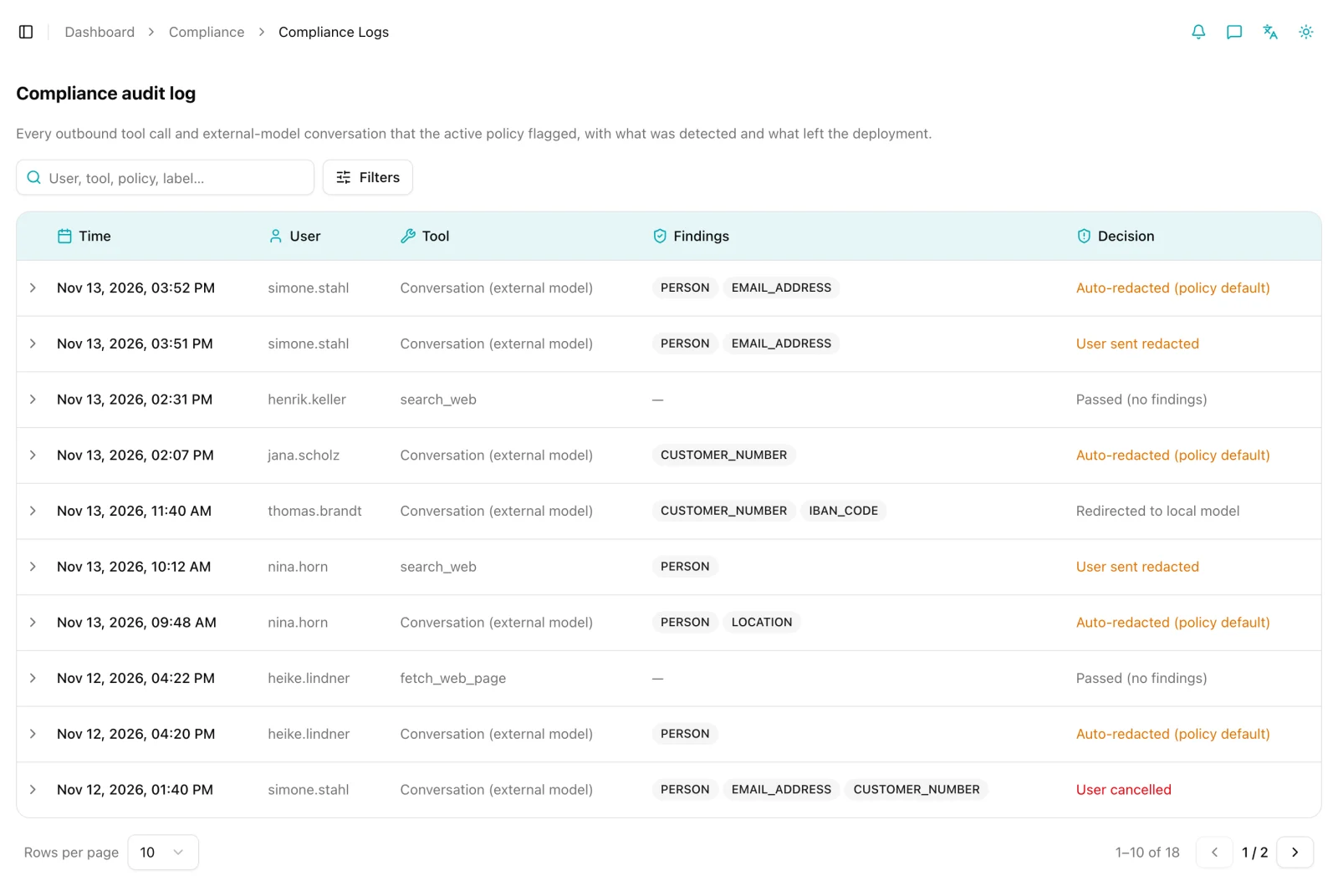
- simone.stahlNov 13, 2026, 3:51 PMPERSONEMAIL_ADDRESSUser sent redacted
- jana.scholzNov 13, 2026, 2:07 PMCUSTOMER_NUMBERAuto-redacted (policy default)
- thomas.brandtNov 13, 2026, 11:40 AMCUSTOMER_NUMBERIBAN_CODERedirected to local model
- simone.stahlNov 12, 2026, 1:40 PMPERSONEMAIL_ADDRESSCUSTOMER_NUMBERUser cancelled
Example. Company, names and figures are invented.
GDPR
Data minimisation and accountability: placeholders instead of personal data, and every decision documented.
Trade Secrets Act
Trade secrets are only protected if you can demonstrate appropriate measures. HEIMDALL is such a measure, log included.
EU AI Act
Operator duties and transparency: you know and can prove which data reached which AI system.
NIS2 · ISO 27001
Control over outbound data as a technical measure you can audit.
Rollout
One afternoon to running.
Upload the policy, confirm the rules, start observation mode. One appointment is all it takes. The rollout is built in. In three stages.
Observe
In observation mode you see what HEIMDALL would have caught, without it intervening.
Warn
In warning mode HEIMDALL asks whenever content is flagged, naming the policy that applies. So you always know why it asks.
Enforce
Enforcement only starts once your metrics reach the agreed corridor.
We measure accuracy on your policy. And we do it before activation.
Without the cloud
Cloud only when you want it.
Out of the box, the cloud is switched off. Local models never pass through HEIMDALL, because everything stays in the house. Only when you pick a cloud model in LOKI does it check every request.
Inside LOKI. At the edge towards the outside.
On your hardware.
HEIMDALL runs as part of LOKI. Detection runs entirely in house, too.
For every cloud model.
Works with any provider offering an OpenAI-compatible interface. Change the model and your protection stays.
There and back.
On the way out, only placeholders leave the house. On the way back, the answer is translated back locally.
Platform
Four tools. One platform.
HEIMDALL is built into LOKI: every cloud request from LOKI passes through it. It can also be booked on its own.
LOKI
Answers questions from your documents, mails and databases. With sources.
Take a lookMINERVA
Design partner program
Understands your machines: sensors, anomalies, condition-based maintenance.
Take a lookHEIMDALL
Decides what cloud AI sees and what stays in-house.
This pageSAGA
Takes the minutes of your meetings and drafts the record. Everything stays in house.
Take a lookHEIMDALL. You decide what the cloud sees.
Your people already use cloud AI. You decide what they hand over.
30 minutes are enough for a first read on your policies: what is regulated today, what HEIMDALL makes of it, what your observation mode would look like.
HEIMDALL runs on your hardware, as part of LOKI. We only quote accuracy figures once they have been measured on your policy. And they are measured before activation.